Words Have Jobs Inside Sentences
In the first lesson, you learned that a part of speech is a word job. Now we will look at how the job becomes clearer when the word sits inside a Vietnamese sentence. The same word may feel confusing alone, but the surrounding words usually tell you what it is doing.
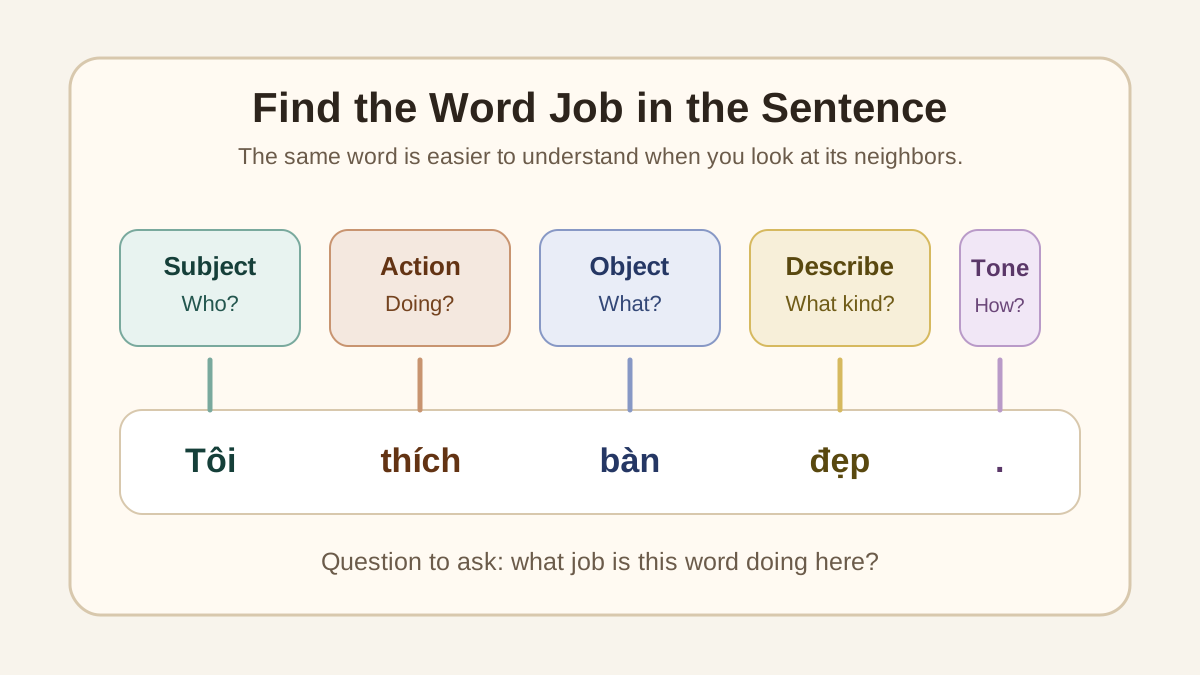
A Useful Pattern
A simple Vietnamese sentence often starts with a subject, then an action or state, then the thing being discussed. Describing words often come after the noun they describe.
This is not a strict rule for every sentence, but it is a strong beginner pattern: subject, action, object, description, and structure words.
Tôi học tiếng Việt.
I study Vietnamese.
Tôi is the subject pronoun, học is the action, and tiếng Việt is the thing being studied.
Tôi thích bàn đẹp.
I like the beautiful table.
Tôi is the subject, thích is the verb, bàn is the noun, and đẹp describes the noun after it.
Cái bàn này đẹp.
This table is beautiful.
Cái helps mark the countable thing, bàn names it, này points to it, and đẹp describes it.
Common Vietnamese Clues
Pronouns often appear near the beginning when they are the subject. Verbs often come after the subject. Adjectives often come after nouns. Classifiers often appear before countable nouns. Particles can change tone, emphasis, or sentence meaning.
When you learn a new word, save one short phrase with it. That phrase teaches the word's job better than the word alone.
Review Some Verbs
Vocabulary
bay
fly
biết
know, be aware, understand (a fact/skill)
biểu
perform; express
buồn
sad, unhappy, mournful
bán
sell, vend
Bảo
tell; protect
bật
turn on, switch on, flick on, spring up
bắt
catch; force
bắt đầu
start, begin, commence
chia
divide; share
chia sẻ
share, spread, distribute
chiên
fry; fried